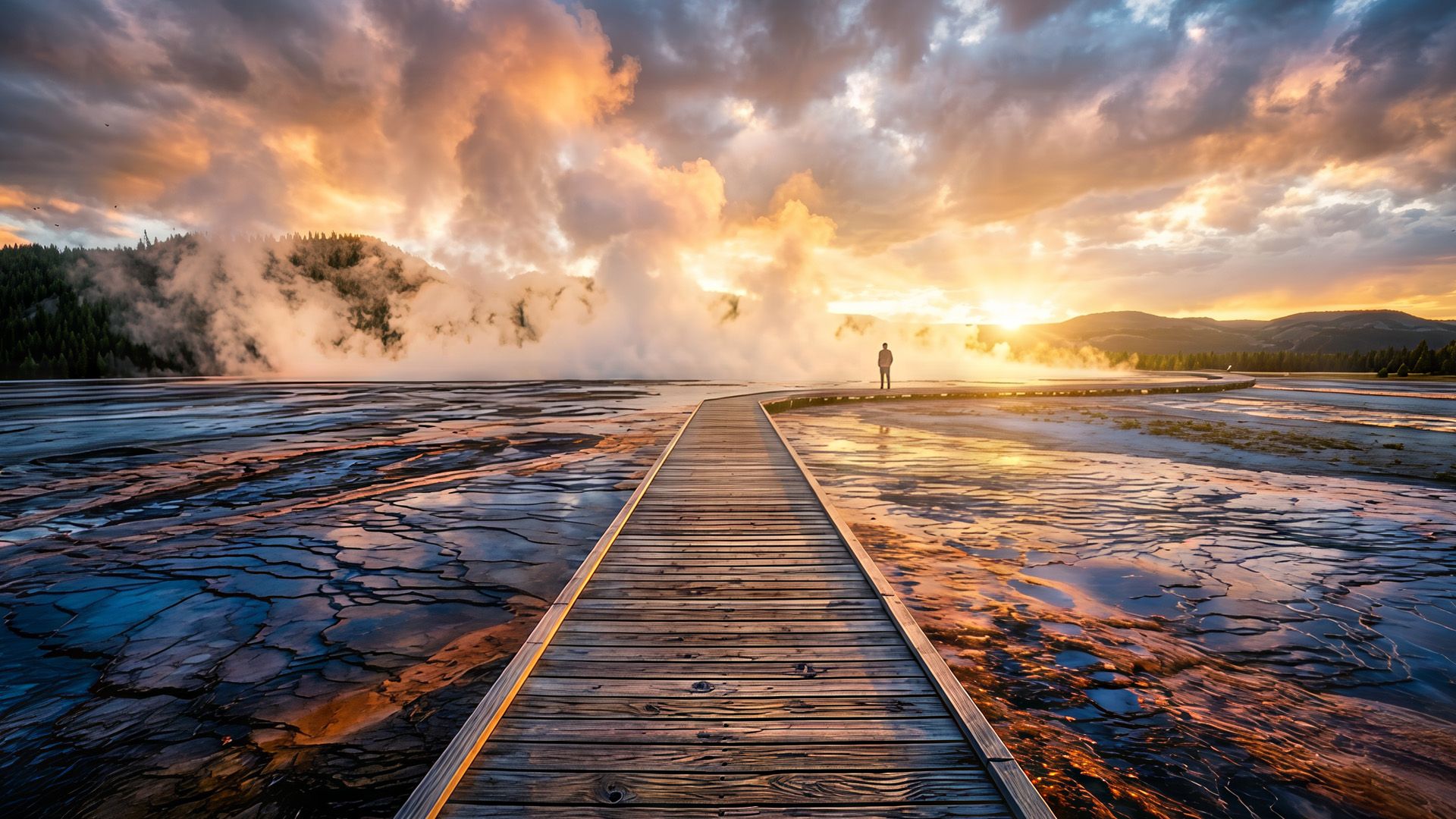
Fire & Ice — Yellowstone's geothermal heart
Yellowstone sits on one of the world's largest active supervolcanoes. The heat that builds beneath the surface emerges through more than 10,000 thermal features — geysers, hot springs, fumaroles, and mud pots — spread across a landscape that in winter becomes one of the most visually dramatic places in North America.
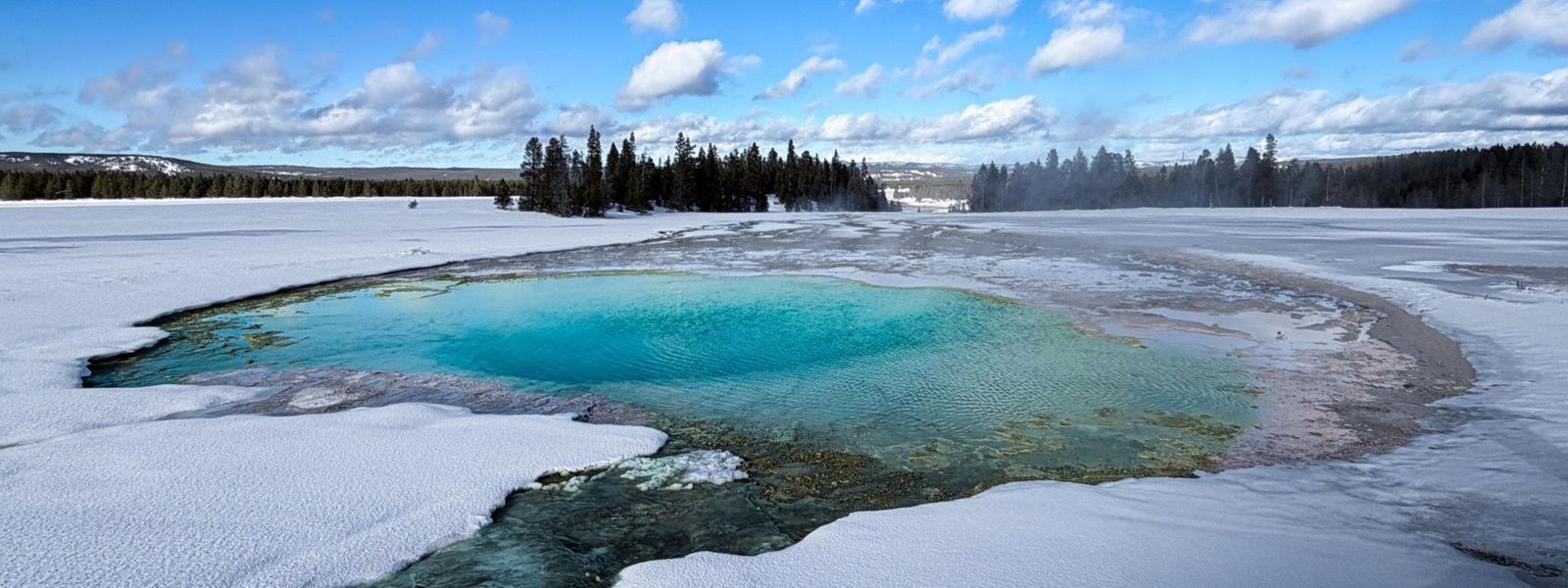
Grand Prismatic Spring is the largest hot spring in the United States and the third largest in the world — 370 feet across and more than 120 feet deep, its colors shifting from deep blue at the center through green, yellow, and orange at the edges as the water temperature drops and microbial mats change. From the boardwalk, the scale is difficult to comprehend. From the elevated overlook on the hillside to the west, the full rainbow pattern opens up in front of you, steam rising in the cold air, the color so saturated it looks artificially rendered. It is not.
The Midway Geyser Basin boardwalk, which leads out over the steaming river to Grand Prismatic Spring, is one of Yellowstone's most otherworldly walks. In winter, the condensation from the surrounding hot springs coats everything in frost — the boardwalk railings, the nearby trees, the ground itself — creating an ice-encrusted landscape that exists only because of the heat below it.
Winter Wildlife — The season that shows you everything
Winter strips the park of its easy distractions. The wildflowers are gone. The hiking trails are buried. The casual visitor has left. What remains is the wildlife, the geothermal features, the silence, and the light — and in that silence, every sighting carries a weight it does not have in summer.
The American bison is Yellowstone's most iconic resident — and in winter, the most visible. Herds move slowly through the deep snow, using their massive heads as plows to push aside the drifts and reach the frozen grass beneath. Their thick winter coats are often covered in frost and ice by morning, steam rising from their backs in the cold air. Bulls can weigh over 2,000 pounds — and yet they move through the deepest snow with a patience and purpose that makes the effort look effortless. A bison herd on the road means you wait. There is no alternative.
The Madison River, kept partially open by geothermal inflows throughout the winter, is one of the park's most productive wildlife corridors. Bald eagles hunt the open water. Otters work the edges. Coyotes trot the banks, watching the eagles. And in the stillness of a winter morning, with steam rising off the river and the valley walls white and silent, the Madison is one of the most beautiful places in the American West.
The elk that remain in the park through winter — rather than migrating to lower ground — are among the most impressive animals you will encounter in Yellowstone. A large bull elk in winter coat, his rack heavy with ice, standing in a snow-covered meadow at dawn, is one of the park's rare and genuinely moving sights. Sightings are uncommon enough that each one feels significant.
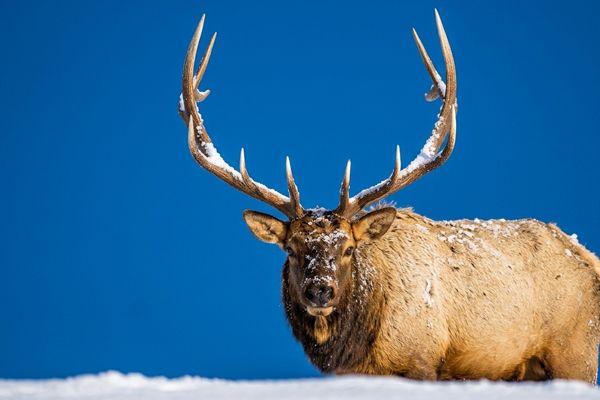
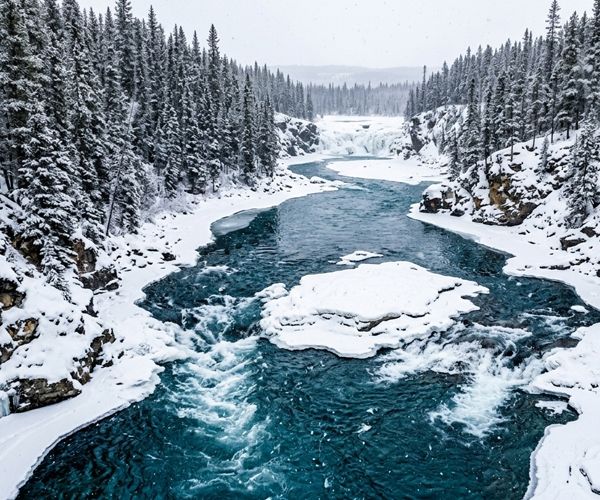
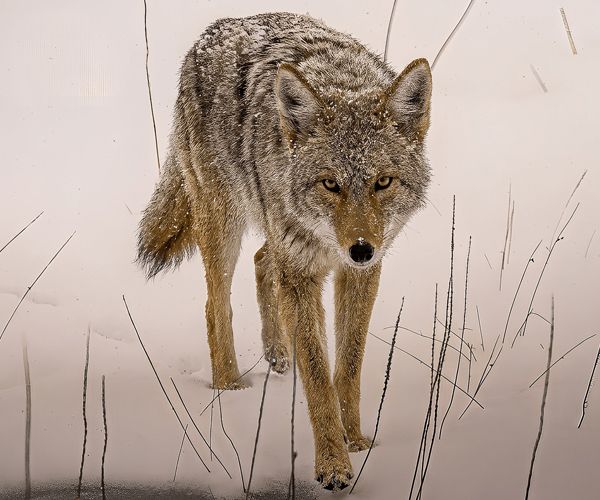
Left to right: A bull elk in Yellowstone in winter — a rare sighting that rewards the early riser and the patient photographer; the Madison River kept partially open by geothermal inflows, one of the park's most productive year-round wildlife corridors; and a Yellowstone coyote — a year-round resident that becomes more visible in winter as cover disappears.
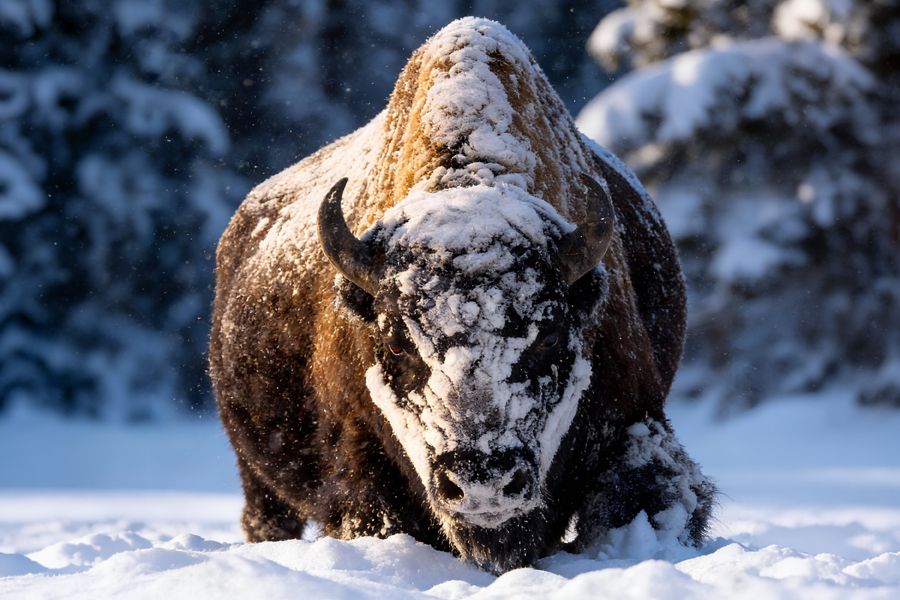
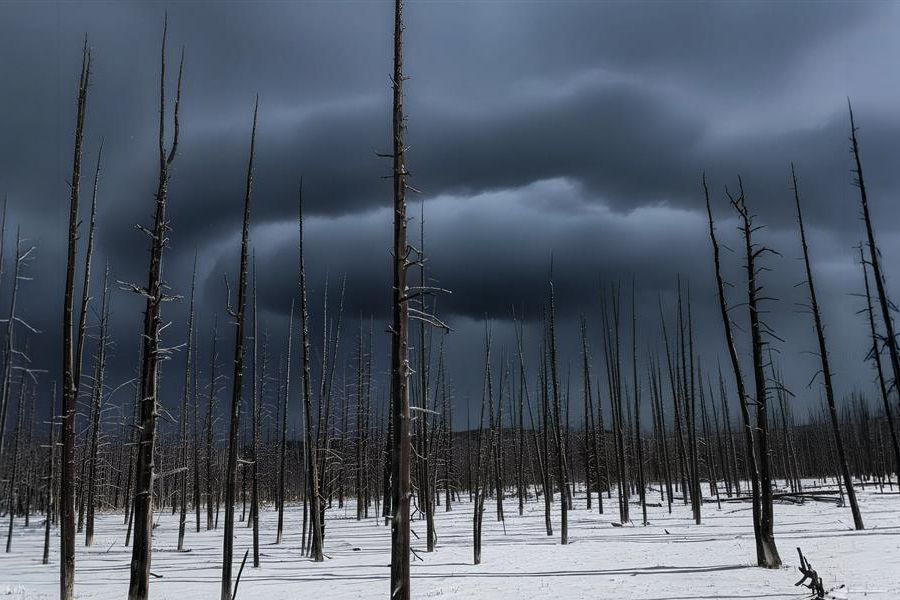
Left: A bison bull plastered with snow after a night blizzard — the frost-covered coat is a visual record of everything the animal has endured to reach morning. Right: Dead forest with storm clouds building — a reminder that Yellowstone's scale encompasses not just wildlife but entire weather systems forming and dissolving over the caldera.
Predators — The animals that make the ecosystem work
Yellowstone is one of the only places in the lower 48 states where the full predator-prey ecosystem — wolves, grizzly bears, mountain lions, coyotes, and bobcats — remains functionally intact. In winter, when the vegetation is gone and the sightlines are long, the predators become visible in a way that summer never allows.
The reintroduction of gray wolves to Yellowstone in 1995 is one of the great conservation stories of the 20th century. By the time wolves were removed from the endangered species list in this region, the elk herds had been restructured, the riparian vegetation had recovered along river corridors, and the entire ecosystem had shifted in ways that ecologists are still documenting. The black wolf — a melanistic color variant that occurs naturally in the Yellowstone population — is among the most sought-after sightings in North American wildlife photography. Spotting one requires early mornings, long lenses, and a great deal of patience at the ridge above Lamar Valley.
The bobcat is one of Yellowstone's most elusive residents — rarely seen, rarely photographed, and entirely indifferent to its reputation. The stretch of road near the park's northern boundary known as Bobcat Alley is one of the few locations in North America where reliable bobcat sightings are possible in winter. The cats hunt the rocky outcroppings above the road, using the elevation to survey the terrain below. In early morning light, a bobcat on a snow-covered ledge is one of the most technically demanding and visually rewarding wildlife photographs the park offers.
Above the predators, the bald eagle watches the Madison and Yellowstone Rivers from preferred perches — cottonwood branches above the open water where the fish are concentrated. Yellowstone hosts one of the densest winter bald eagle populations in the lower 48, drawn by the geothermally maintained open water that other rivers lose to ice. A bald eagle hunting over a steaming river, with snow on every surface, is a composition that justifies the cold entirely.
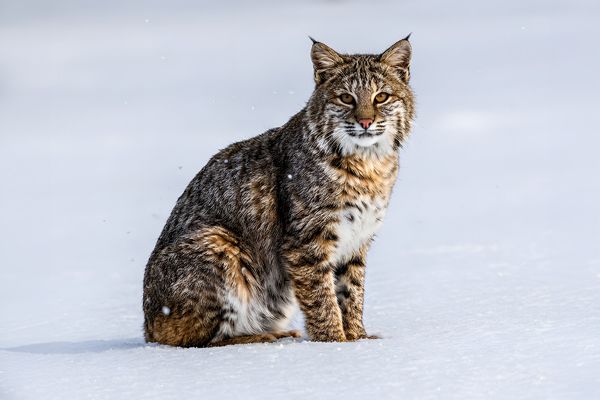
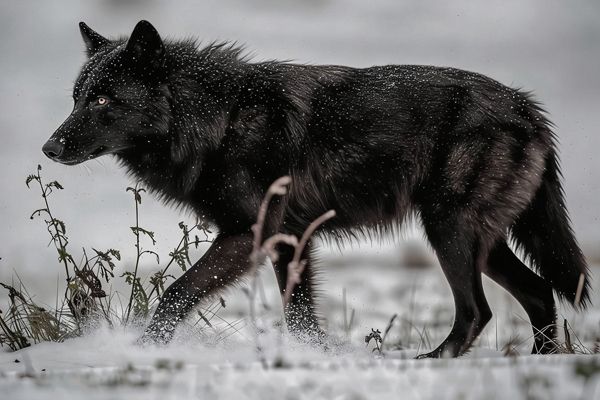
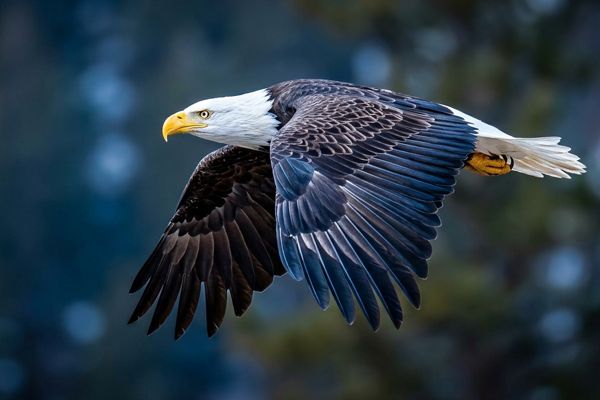
Left to right: A bobcat in Bobcat Alley — one of Yellowstone's most elusive residents, hunting the rocky outcroppings above the road at dawn; the black wolf — a melanistic color variant unique to the Yellowstone population, one of the most sought-after sightings in North American wildlife photography; and a bald eagle over the Madison River — drawn by the geothermally-maintained open water that freezes solid everywhere else.
Big Sky — The landscape that frames everything
Montana earns its nickname. The sky here is not merely large — it is a presence, an active participant in every photograph, changing the light on the land below with a speed and drama that keeps you watching the horizon as much as the foreground. In winter, under storm light, the sky above Yellowstone is some of the most photogenic in North America.
The Great Grey Owl is one of the largest owls in North America — and one of the most photogenic. It hunts by hearing rather than sight, capable of detecting prey moving beneath two feet of compacted snow, diving through the surface to catch voles and mice that never knew it was above them. In Yellowstone's northern range, Great Grey Owls hunt the open meadows along the road system in winter, occasionally perching in full view on fence posts and low branches. The combination of their size, their silent patience, and the snow-covered landscape make them one of the most compelling wildlife subjects the park offers.
The full-bleed landscape of Yellowstone in winter — the one that appears in the pull-back shots, the wide frames, the images that try to capture what the place feels like rather than what any single animal looks like — requires a different approach. You need elevation. You need patience with the light. And you need to accept that the most honest photographs of this landscape include the sky, because the sky is where half the story is being told.
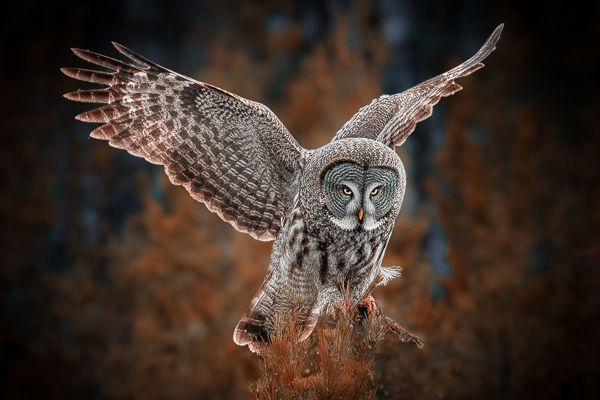
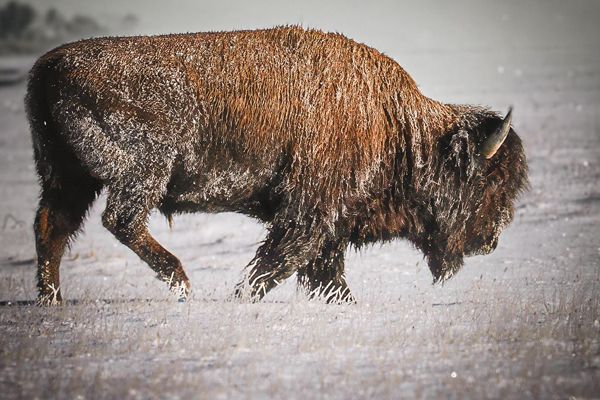
Left: The Great Grey Owl — one of the largest owls in North America, capable of detecting prey moving beneath two feet of compacted snow, diving through the surface to catch voles that never knew it was above them. Right: A bison bull moving through fresh powder — Yellowstone's most iconic resident, unbothered by conditions that shut down highways and close national parks.
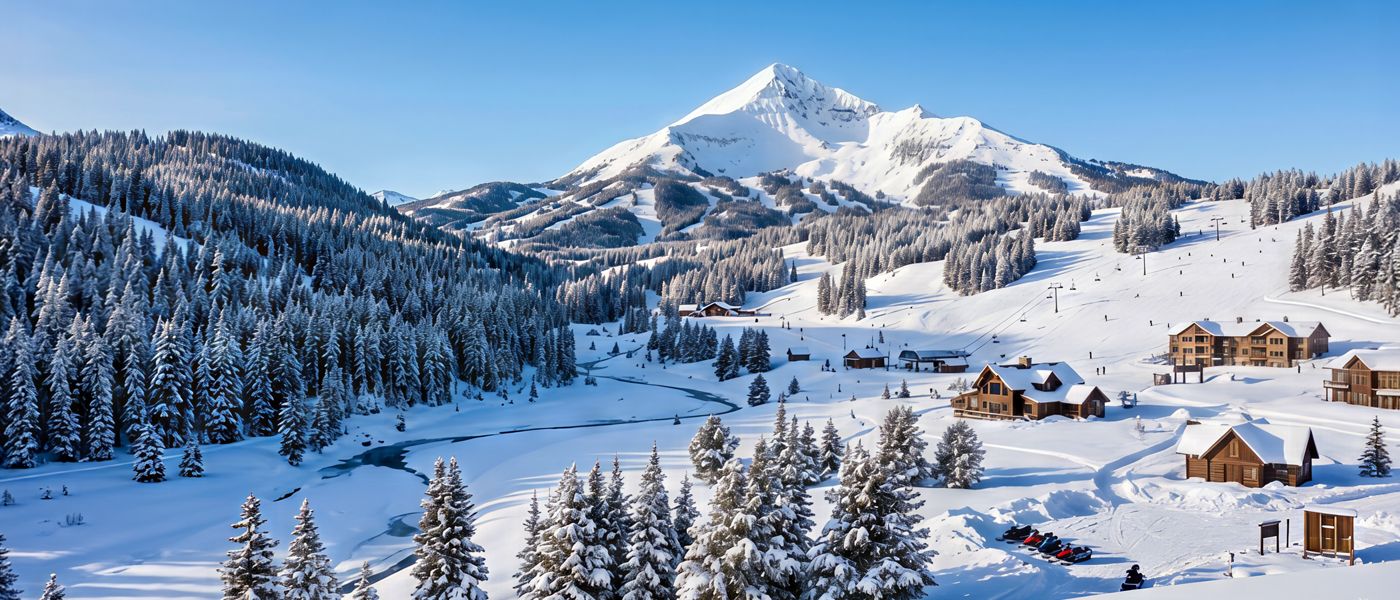
Winter does not diminish Yellowstone. It removes everything that was making it comfortable, and what remains is the actual thing — the wolves, the geysers, the bison, the cold, and the sky above it all, performing without an audience.
Experience Yellowstone
through Jango's lens
Winter expeditions to Yellowstone and the northern range — timed around the wolf activity in Lamar Valley, the geothermal features in full steam, and the light that only exists when the temperature drops below zero.
Inquire About a Workshop More Destinations