Quito — A city that lives in the clouds
At 2,850 meters above sea level, Quito is the second-highest capital city in the world and one of the best-preserved colonial cities in the Americas. Give yourself a day to acclimatize before you do anything ambitious. The city rewards patience.
The historic center of Quito — a UNESCO World Heritage Site since 1978 — is one of the most intact examples of colonial urban planning in Latin America. The streets rise and fall with the Andean terrain they were built on, and around every corner there is another baroque church, another tiled courtyard, another view of the surrounding volcanoes breaking through the cloud.
Basílica del Voto Nacional is the largest neo-Gothic church in the Americas and the visual anchor of the old city. Walk the rooftop gargoyle walkway — one of Quito's more quietly thrilling experiences — for the finest elevated view of the city and the volcanoes beyond. Construction began in 1892 and, technically, never ended: the church remains officially unconsecrated, based on the belief that once it is completed, Ecuador will face the apocalypse. No one appears to be in a hurry to finish it.
Calle La Ronda is the old city's most atmospheric lane — a narrow cobblestone street of whitewashed colonial buildings, small artisan workshops, cafés, and galleries. In the evening, when the tourist traffic eases, it becomes genuinely beautiful. The Diablo Huma — the two-faced devil character of Andean folklore — performs here during festivals, his mask representing the duality of day and night, the living and the dead.
From the hilltop of El Panecillo, the Virgin of El Panecillo watches over the city — a 30-meter aluminum statue visible from almost anywhere in Quito, her wings spread, standing on a globe encircled by a serpent. She is a modern icon built from 7,000 aluminum pieces, and she photographs best in the early morning light before the haze builds.
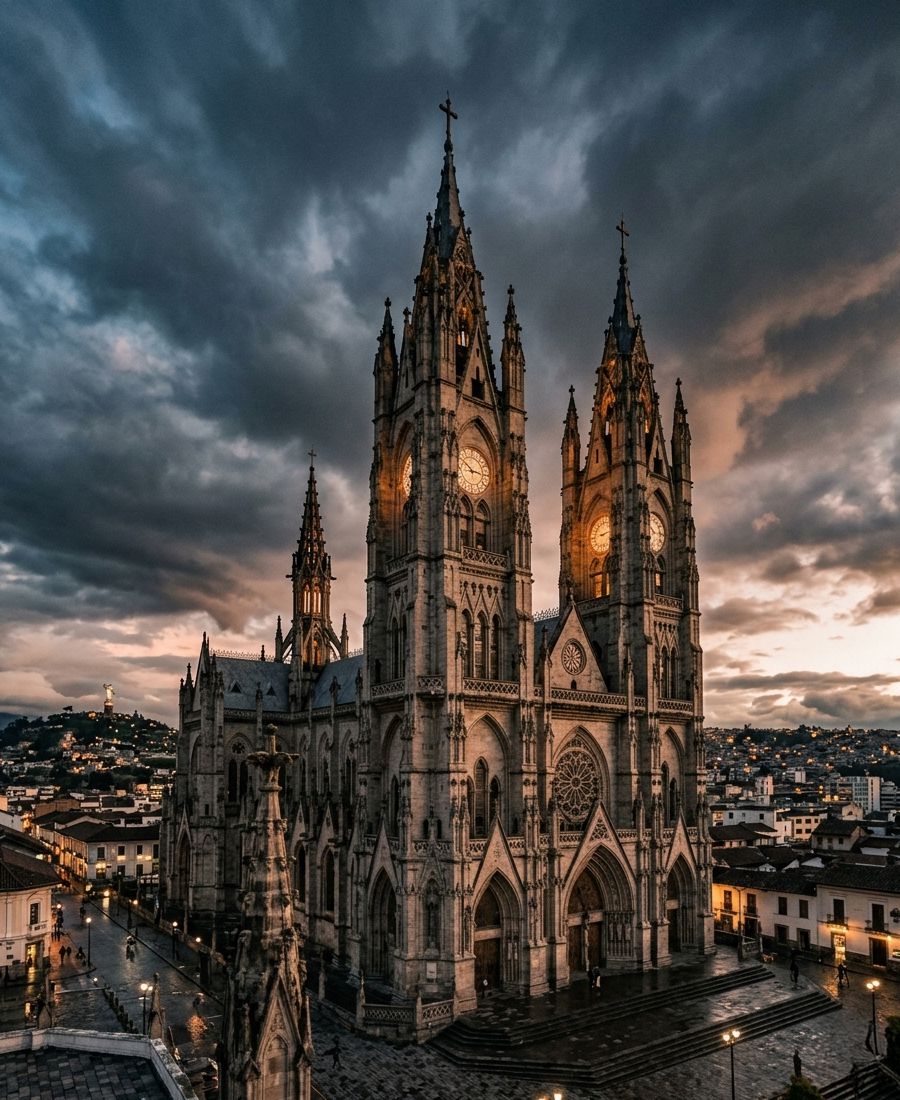
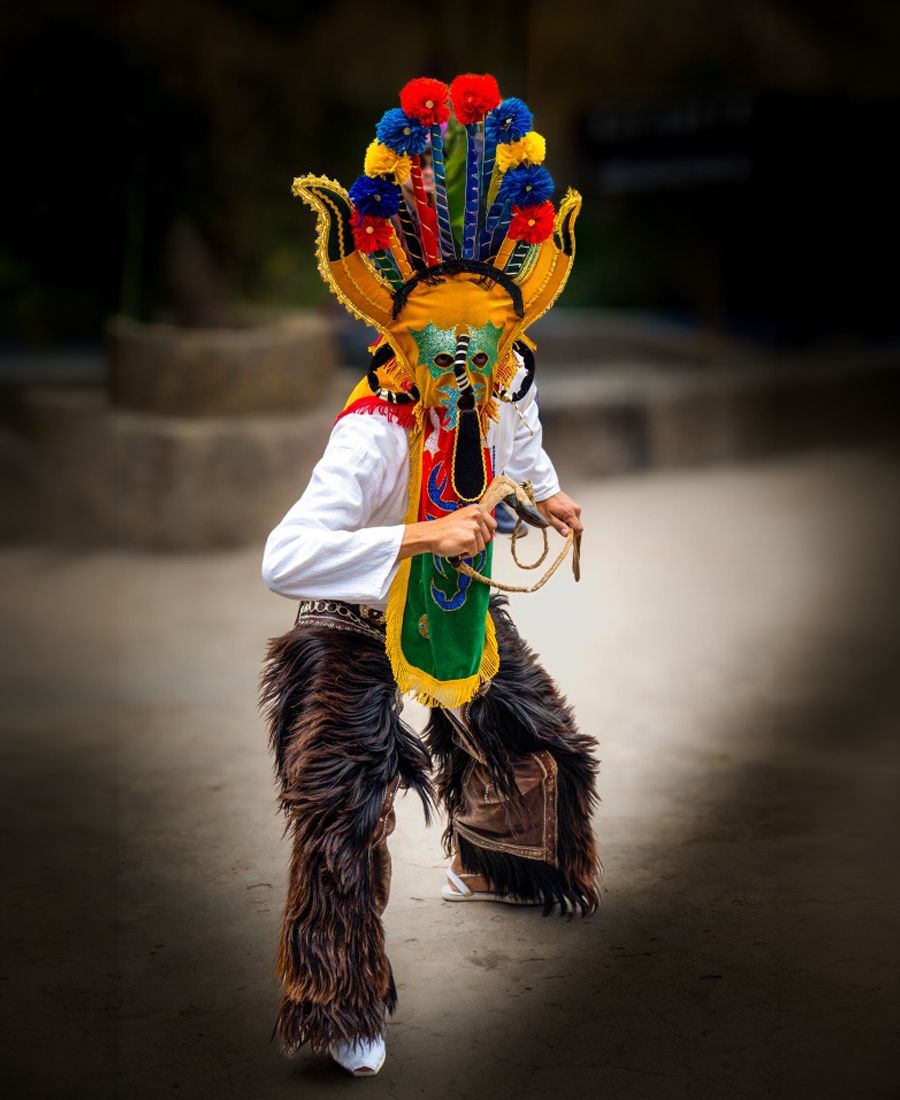
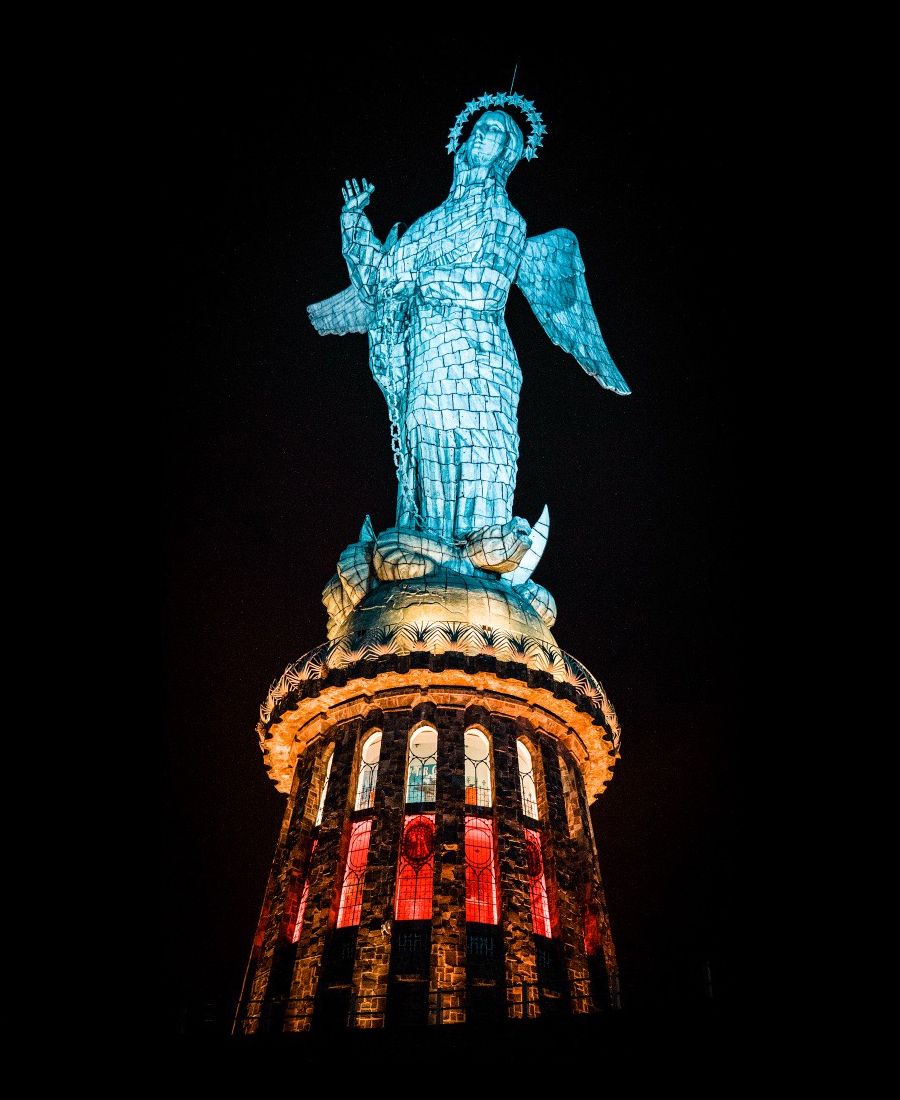
Left: The neo-Gothic towers of Basílica del Voto Nacional — the largest church of its kind in the Americas, and still officially unfinished after more than a century. Top right: The Diablo Huma, Quito's great folkloric character — two faces, one mask. Bottom right: The Virgin of El Panecillo keeping watch over the city.
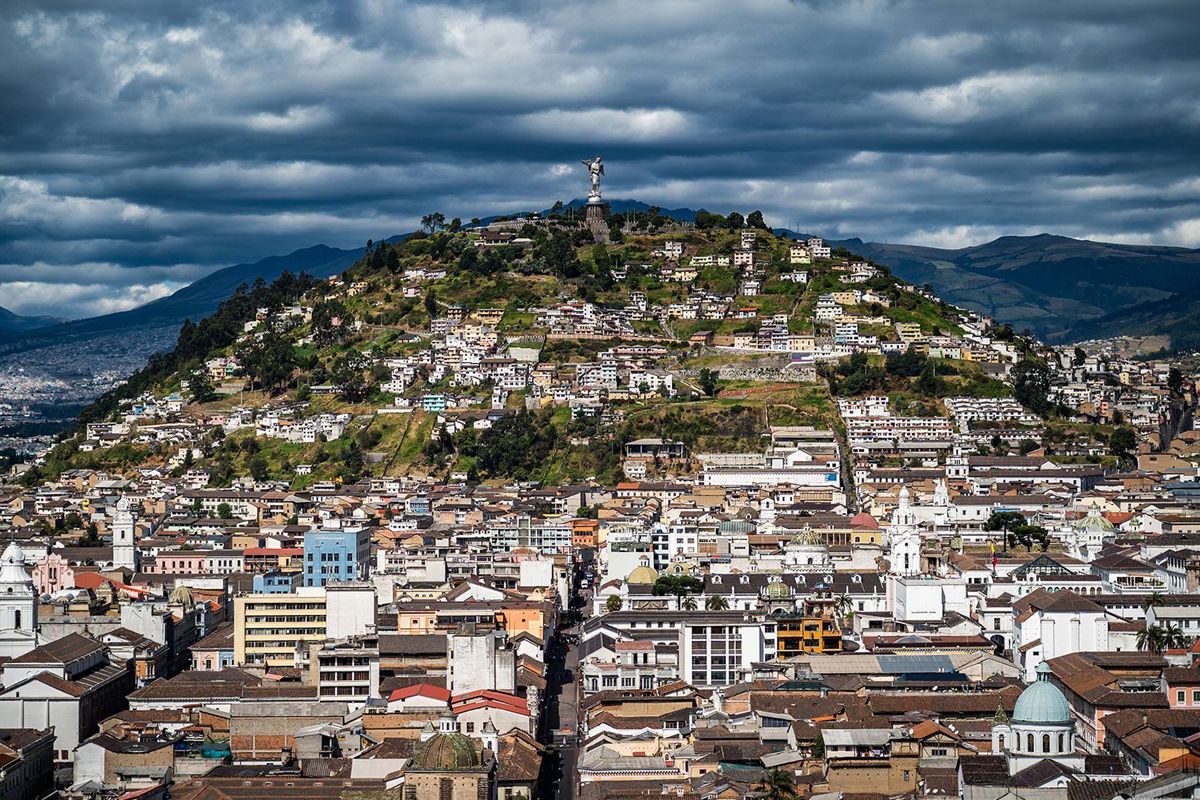
Quito spread across its valley — ringed by volcanoes, draped in cloud, and home to one of the finest colonial centers in Latin America.
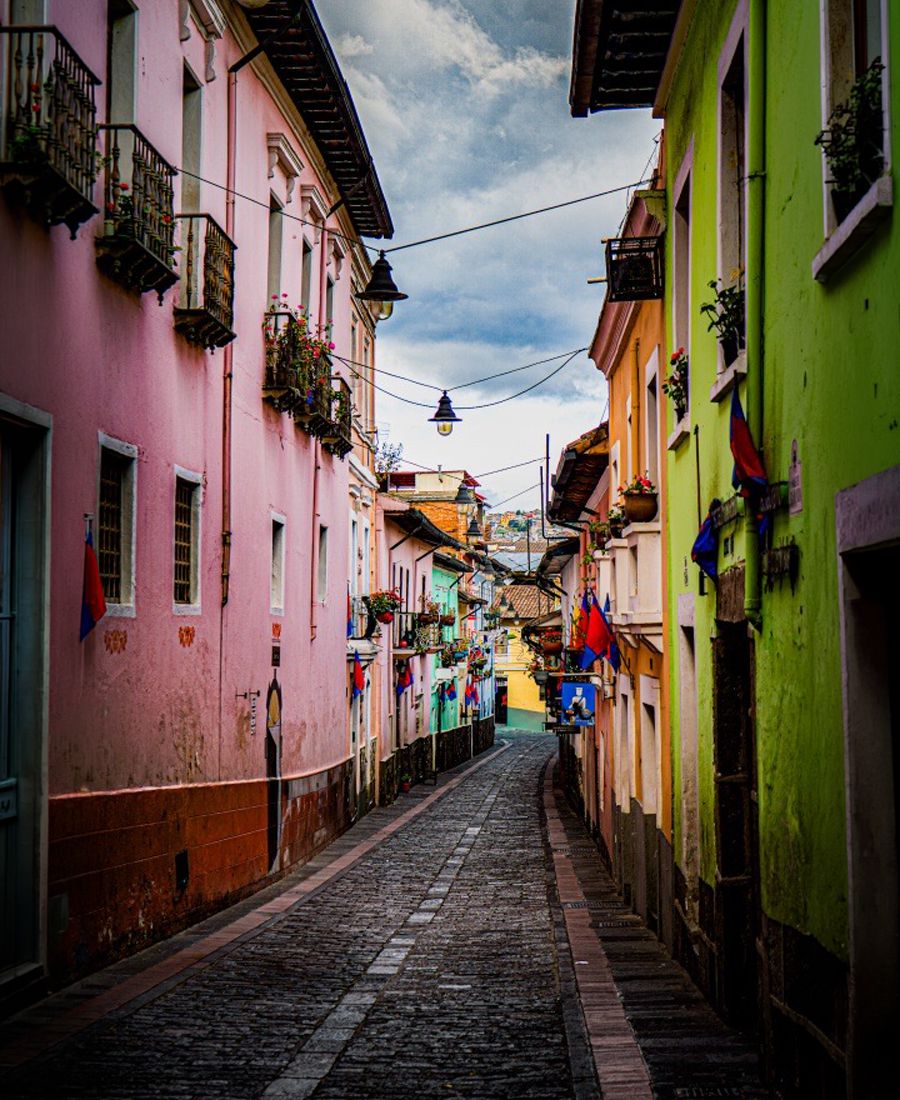
Calle La Ronda — the old city's most intimate street. Best explored on foot, slowly, in the evening when the light is soft and the crowds have thinned.
Mindo — The cloud forest drips with life
Drive two hours northwest of Quito and the altitude drops, the temperature climbs, and the world turns green in every direction. Mindo sits at the heart of the Chocó Andean Bioregion — one of the most biodiverse places on earth, and one of the most important birding destinations in the western hemisphere.
Ecuador is home to over 1,700 bird species — roughly 17% of all bird species on earth, packed into a country the size of Nevada. Of the world's 43 recognized toucan species, 17 are found in Ecuador — making it one of the richest destinations on earth for the family. Mindo alone hosts five of them, drawing birders from around the world to a single cloud-forested valley.
The Chocó Toucan is one of the most striking birds you will encounter in the Mindo cloud forest — its massive yellow and black bill a spectacular piece of evolutionary extravagance. The Crimson-Rumped Toucanet and the Plate-Billed Mountain Toucan, with its extraordinary laminated bill, complete a trio that alone justifies the journey from Quito. The Lettered Aracari, a smaller member of the toucan family with its vivid banded plumage, rounds out a remarkable concentration of the family in a single location.
But the toucans are only part of the story. Ecuador has more hummingbird species than any other country — over 130. The Brown Violetear, the Green-Crowned Brilliant, and the tiny Purple-Throated Woodstar are just three of the species that hover and dart through the cloud forest with a speed and iridescence that defeats most camera autofocus systems. The solution is a flower-lined feeding station at dawn, a tripod, and infinite patience.
Away from the birds, the Green Honeycreeper and the Rose-Faced Parrot add vivid color to the forest canopy. And moving more slowly through the undergrowth, the Andean Bear — South America's only bear species, also known as the spectacled bear — makes occasional appearances in the forests around Mindo. Shy, solitary, and increasingly rare, a sighting is never guaranteed. Which is precisely what makes one unforgettable.
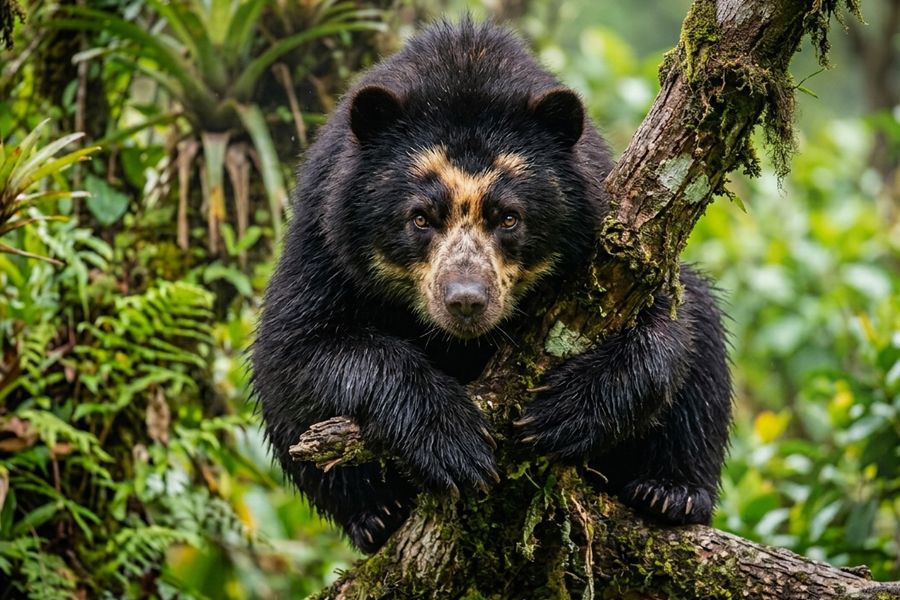
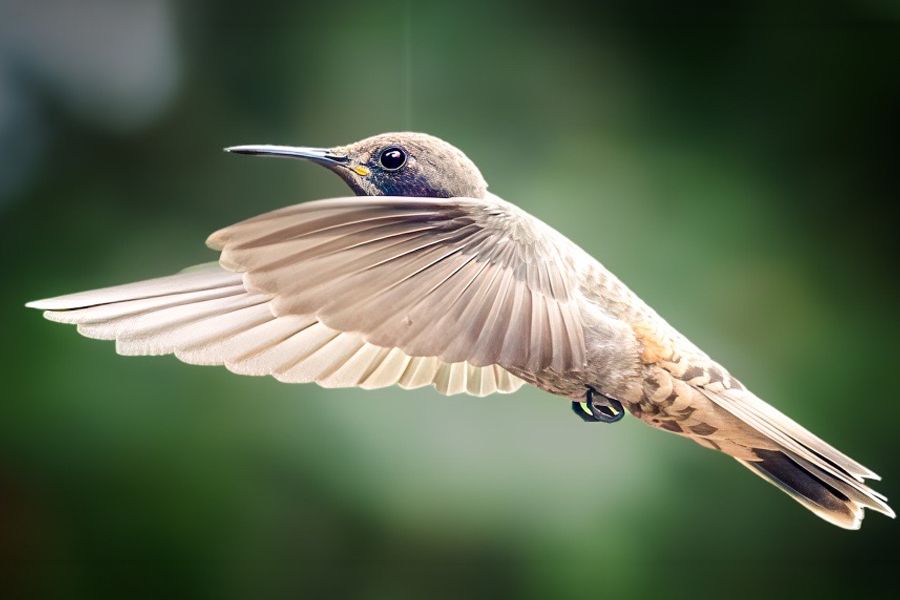
Left: The Andean bear — South America's only bear species, and one of the most elusive mammals in the cloud forest. Right: The Brown Violetear hummingbird — one of over 130 hummingbird species found in Ecuador.
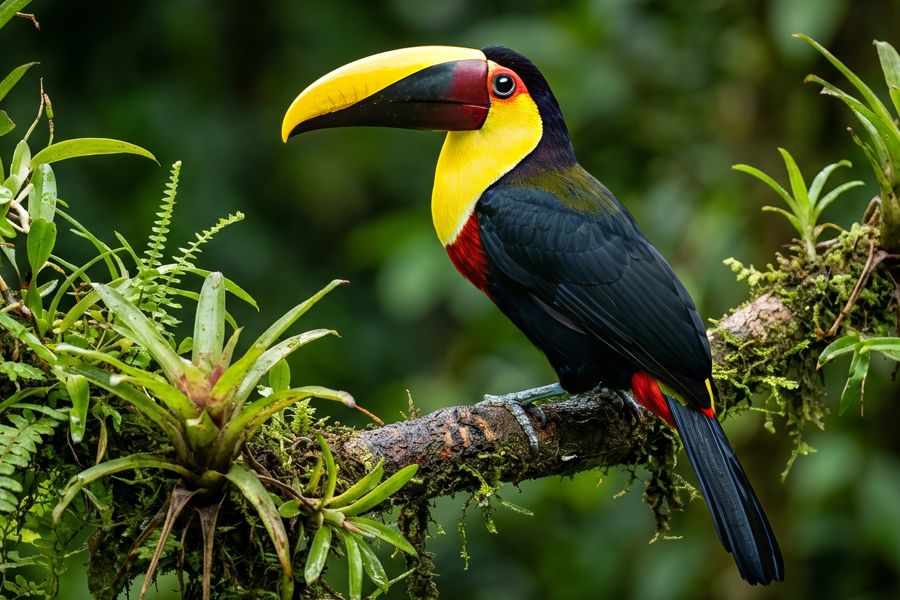
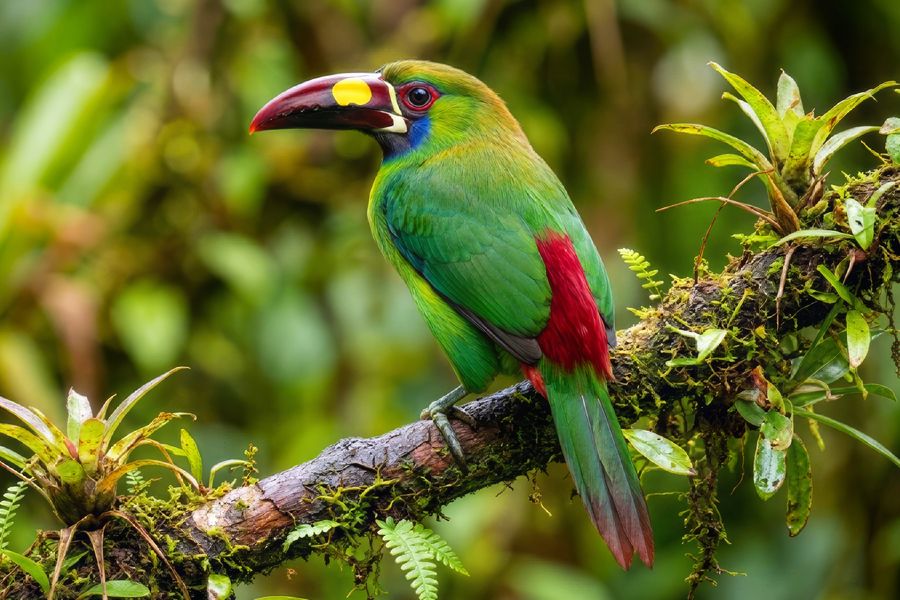
Left: The Chocó Toucan — a flagship species of the cloud forest and one of 17 toucan species found in Ecuador. Right: The Crimson-Rumped Toucanet — smaller, faster, and just as vivid.
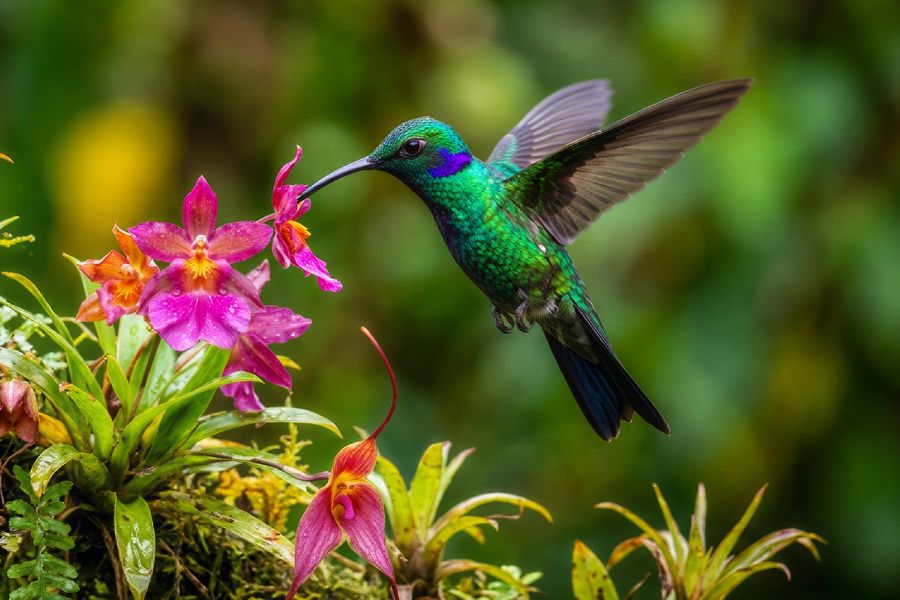
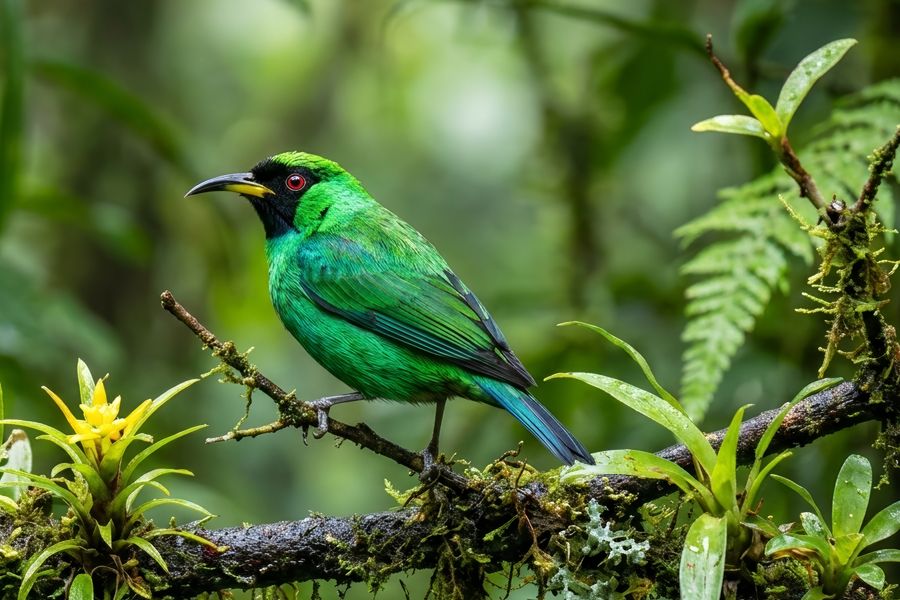
Left: The Green-Crowned Brilliant — a large hummingbird of the cloud forest edge, its crown catching the light like a gemstone. Right: The Green Honeycreeper — a vivid turquoise bird found in forest canopy across Ecuador.
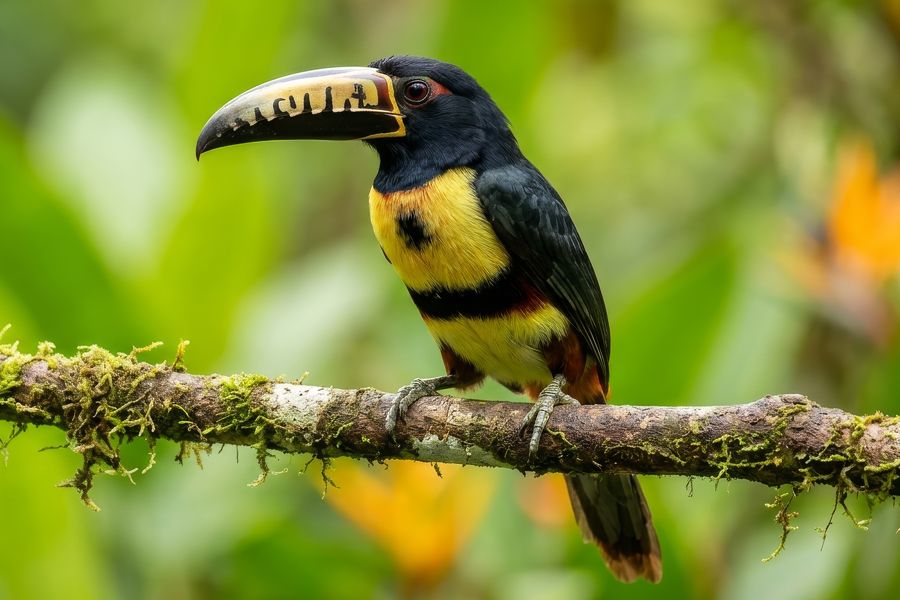
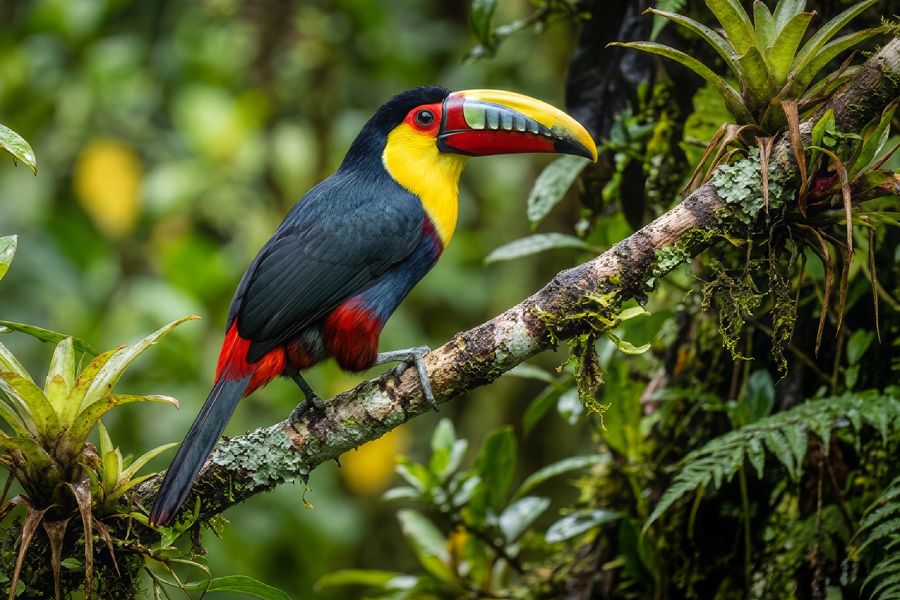
Left: The Lettered Aracari — a smaller member of the toucan family, its banded plumage as carefully patterned as a piece of textile art. Right: The Plate-Billed Mountain Toucan — identifiable by its extraordinary laminated bill, one of the most architecturally improbable bills in the bird world.
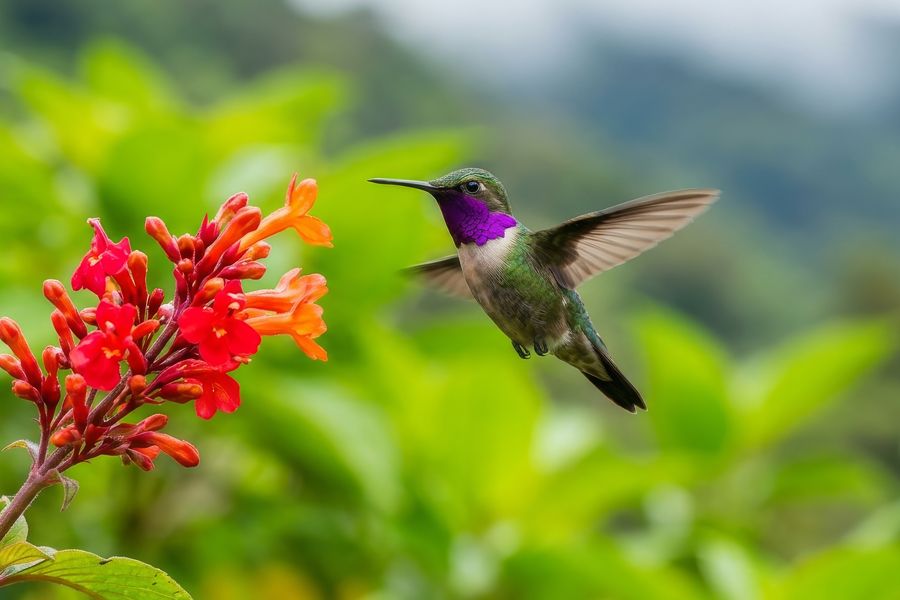
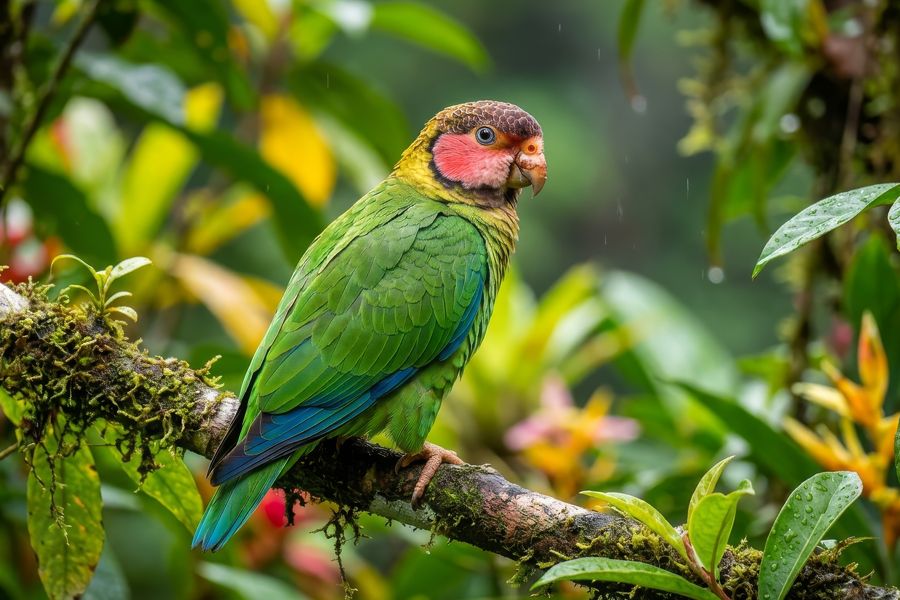
Left: The Purple-Throated Woodstar — one of the smallest hummingbirds in Ecuador, its gorget catching the light in flashes of deep violet. Right: The Rose-Faced Parrot — a cloud forest resident whose soft rose-colored face is unlike any other parrot in Ecuador.
Ecuador hosts 17% of the world's bird species in a country smaller than Nevada. In Mindo, 400 of them share a single valley. Every morning here is a recalibration of what the word "variety" means.
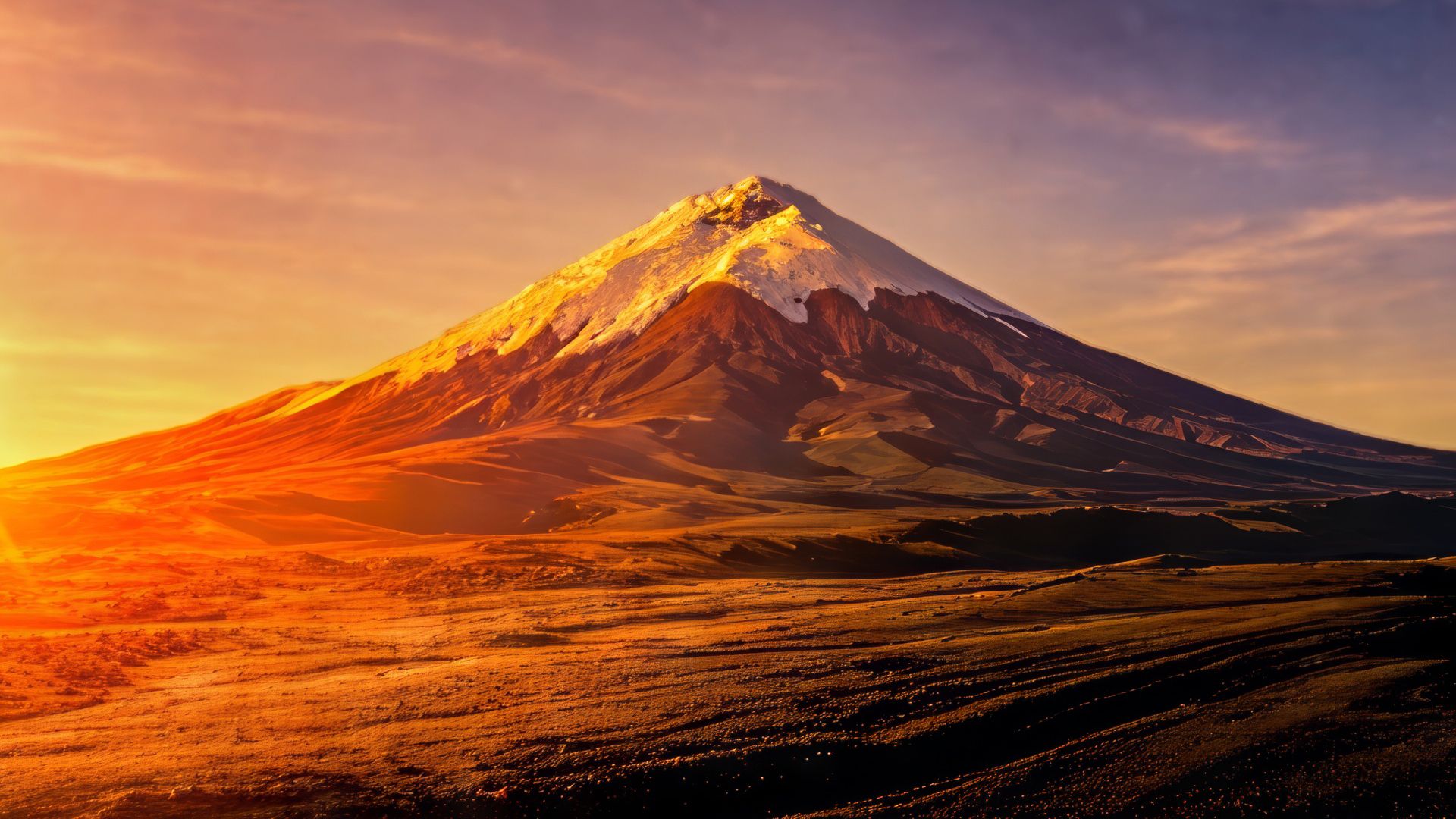
Cotopaxi — The volcano that appears from nowhere
You are driving the Pan-American Highway south of Quito when you take a long bend and the windshield fills with a perfect snow-capped cone. Cotopaxi. At 5,897 meters, one of the world's highest active volcanoes, and one of the most symmetrical. No photograph fully prepares you for the first sighting.
The national park that surrounds it is a landscape of high-altitude páramo — a treeless grassland ecosystem unique to the tropical Andes, inhabited by Andean condors, carunculated caracaras, and herds of wild horses that move across the plain with the volcano rising behind them. The air at 3,800 meters is thin enough to slow every step and sharpen every color.
The summit glacier has retreated significantly in recent decades — a visible and sobering record of climate change written in ice. What remains is still immense: a white cap that reflects the last light of the afternoon long after the valley below has fallen into shadow, producing some of the most dramatic available-light photography conditions in South America.
The roads approaching Cotopaxi pass through country where Quechua communities have farmed and grazed livestock for centuries. Small markets appear along the roadside — woven textiles, handmade jewelry, ceramic figures of the volcano itself. Stop, spend time, buy something. These are not tourist traps. They are evidence that someone lives here, on the slope of an active volcano, and has decided that is perfectly reasonable.
Quilotoa — The emerald eye of the Andes
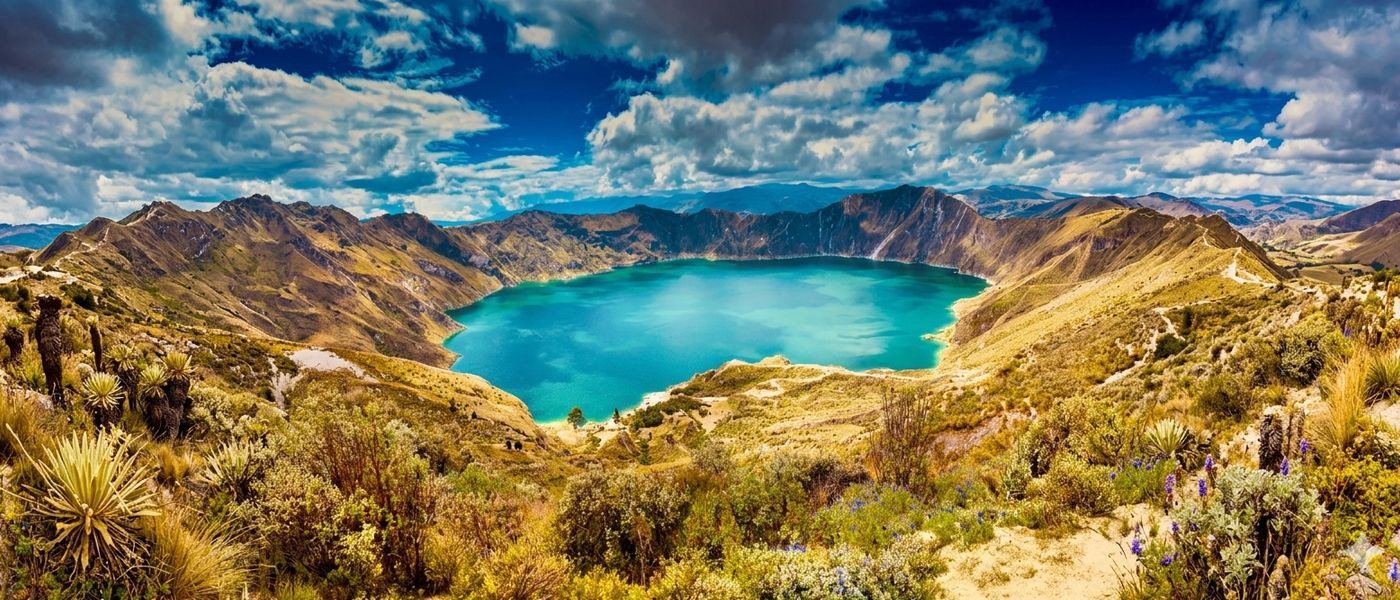
The road to Quilotoa climbs through indigenous villages and potato fields until, at 3,914 meters, you reach the rim of an ancient caldera. Below, filling the bowl of a collapsed volcano, a lake of extraordinary green stretches across the crater floor. The color shifts with the sky — turquoise in sun, deep jade under cloud.
The walk down to the lake takes around 30 minutes. The walk back up is an entirely different conversation. The altitude will humble you in ways that are difficult to predict. Start early, move slowly, and drink water before you begin the descent.
The lake formed approximately 800 years ago when the caldera collapsed following a massive eruption. The extraordinary color comes from dissolved minerals — primarily sulfur — in water that has no outlet and no inflow beyond rainfall. It is, in the truest sense, a closed world.
The indigenous Quechua community of Quilotoa has lived on the crater rim for generations. Local artists sell paintings of the lake — vivid, naive works that capture something about its color that photography sometimes struggles to. The paintings are not souvenirs. They are a different kind of documentation.
Ecuador asks nothing of you except attention. Pay it, and the country delivers — birds, volcanoes, colonial cities, cloud forests, and crater lakes — all within a few hours of each other, all operating at a scale that consistently exceeds expectation.
Experience Ecuador
through Jango's lens
Guided photography expeditions to Quito, Mindo cloud forest, Cotopaxi, and Quilotoa — built around the birds, the light, and the landscapes that make Ecuador one of the most extraordinary destinations on earth.
Inquire About a Workshop More Destinations